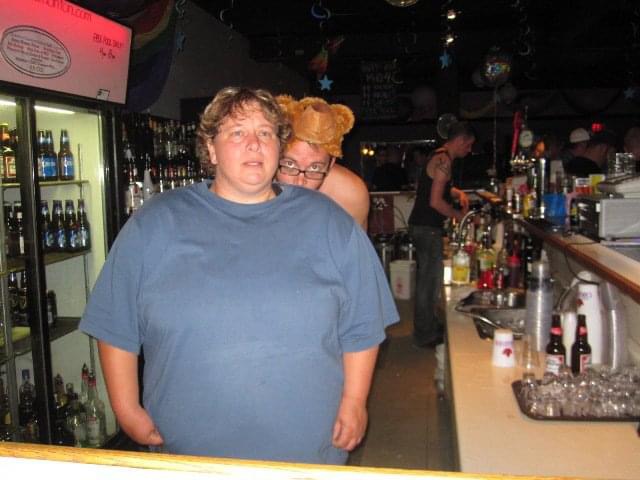
We were at the gay bar when we got the call. “Does anyone know where he is?” No one did. He wasn’t there. But it made sense they could call there for him. He was one of us. It was logical, even likely, that he’d be there, or at least, that someone there would know where he was. A search began, one that ended in tragedy. We were at the gay bar when we got that call too. They knew where he was, now. Or at least, they’d found the body.
They are places for joy, freedom, liberation, celebration, but for many, they are also a place for grieving. A community that comes together regularly at the same watering hole finds family there, and when that family suffers loss, it’s around that watering hole they gather, to share the stories and the tears, to ask the questions, sometimes to find the answers.
I wonder what it was, my first encounter with grief at the gay bar. It certainly couldn’t have been that 2017 night, when Lonny went missing and then was found, and that means it certainly wasn’t that 2018 night, exactly a year later, when we were gathered at the gay bar to remember Lonny, and a phone rang again, with another loss, another set of answer-less questions. And it wasn’t that night in 2014 when the rumors ran rampant through the community about a murder. Nor was it all those nights in 2009 and 2010 when we watched another death slowly happen, a boisterous laugh slowly descending into sickness. Nor even years earlier, in the same bar with the same man, when we got a call, but there was work to do, then shooters to drink, and then and only then, obituaries to write, never even thinking that there would be a night when I’d be sitting there furiously scribbling an obituary for him.
I suspect for me, the first time I linked a gay bar to grief, it was external grief. It was to the gay bar I ran, drunk and overwhelmed with emotions following my cousin’s funeral. Already way back then, in 2002, it was the gay bar family I needed to cope with loss in my “other” family. As that gay bar family grew and grew, so too did the body count.
I’m too young to have lived through a time when gay bars equalled grief in a very different way. I was standing outside where Flashback was the other day, guiding a group on a queer history tour. “Why did Flashback close,” someone asked, and I thought about the recently-released documentary on Edmonton’s “54 of the Prairie” and talked about how much more eloquent it was than I could ever be in explaining the impact of coming to the dance floor every week only to see another empty bar stool, another empty go go box, where the body that used to be there every week, was gone. AIDS reached in with a cold claw and ripped the heart out of so many gay bars.
I wonder what it was like for the staff then. I know the burden of being staff in a gay bar during one of those spontaneous gatherings born by grief. You want to grieve too, but you cannot. You have cocktails to serve, and the people there want your ear, to share their pain; pain shared is often pain lessened. It is only later, when those crowds go home, that you have the chance to share your own pain, with co-workers or close friends. With gay bar family. And maybe, you’re alone at the end of that night, and all that pain can break free from you in a howl that echoes off a wall, like its the latest bass drop from the DJ that was there just before.
Then, as now, as always, the show must go on. There are people gloriously unaffected or unaware by the communal grief so many others are sharing. They have their own lives, their own questions, their own griefs, and they might be there just to drink and dance, no interest in the personal pain their bartender might be feeling. We learned that again in 2014, when the call came that a grandfather who had been failing had finally fallen; but there was literally a show happening, and people needed drinks, and the show needed tech, and it was busy and rent had to be paid, and grief could wait. Grief is patient that way; it can always wait. It will sneak up on you and remind you it’s there when you least expect it. Maybe there’s a note in the latest pop diva hit that pings the part of your brain that heard that same note in some long ago hymn, and suddenly, you remember. Oz is great, but Kansas is always there. The technicolor ends.
Last Call always comes.
And when it does, I hope there’s a space you can go, with people who can share your pain because they shared your love. In the end, isn’t that what it is? Grief is just love. The final outpouring of love that never ends. Love isn’t buried with the body; love isn’t interred with the ashes. The love that was there in the happy hours remains long after Last Call is called. It’s the shooter you pour out and leave sitting at a chair now empty. It’s the sea of Superman shirts on a Sunday afternoon. It’s the guy who comes down to see you when his brother dies because he needs someone and he knows you’ll be there, at the gay bar. It’s the pool tournament in memory of. It’s her crown on display; it’s his picture in spotlight. It’s a spray of tattoo’ed stars for the too many too soon lost to addiction and suicide.
Of course there will be grief in gay bars, because there’s connection and community and love in gay bars. And that’s what I remember.
To Vicky (August 5, 2007), LJ (August 5, 2017), Tina (August 5, 2018)…
To Josh and Josh and Darcy and Ben, to Ashley and Chris and Paul and Sam, to Steve and Dickie and Chris and Gunnar and Bella and Dylan and Brennan and Coco and Matt and Alvaro and Dominic and Sue and Brent and Ryan and Jude, to Ralph and Chuck and Kevin and Kylie and Brandi and Eldin and Pam and Lane and Michelle and Tina and Lori and James and Conrad and Dow and Deb and Jim… and all the other amazing people with numbers on both sides of their dash